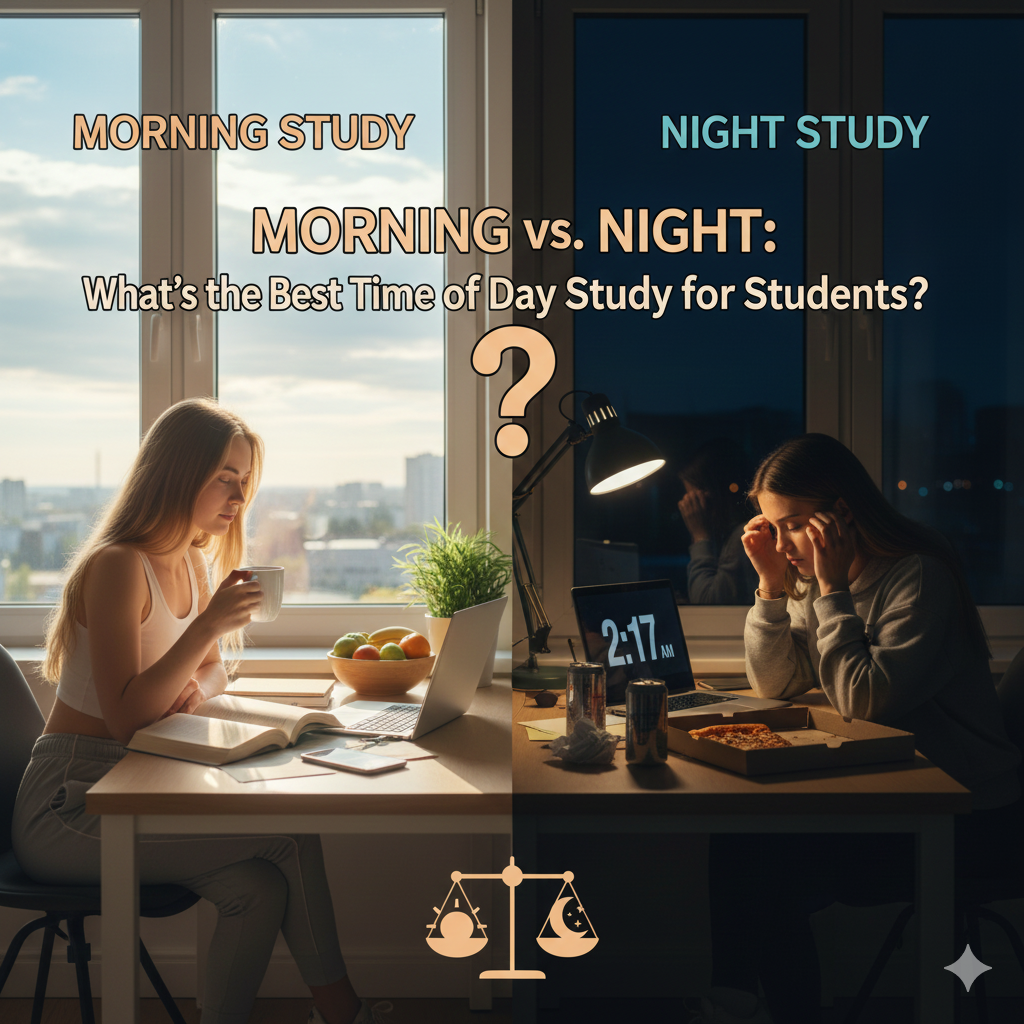
Morning vs. Night: What’s the Best Time of Day to Study for Students?
 🏆 Debate: Morning vs. Night – Why Morning is the Best Time to Study (6 Winning Points)
Good day, sharp students and debaters!
Looking for the winning argument for your next debate? You’ve found it. This template gives you a powerful, ready-to-use script for the motion: “Morning vs. Night: What’s the Best Time of Day to Study for Students?” We are arguing for the morning.
Let’s be clear. Studying at any time is good. But when we talk about the best time for peak performance, the morning has unbeatable advantages. It’s about working with your body’s natural rhythm, not against it.
A quick but important disclaimer: This article provides arguments for one side of an educational debate. It is not meant to dismiss night studiers. Everyone is different! This is purely a tool to help you prepare for your competition and present a compelling case.
Now, let’s get you those winning points.
🗣️ Winning Debate Points on Why Morning is the Best Time to Study
Here are six powerful points you can use directly in your speech. Deliver them with confidence!
### 1. Your Brain is Fresher and Sharper After Sleep
My first point is simple. Think about how you feel after a good night’s rest. Your mind is clear, right? You’re not tired or drained from a long day. That’s because sleep resets your brain. Scientists say your prefrontal cortex – the part responsible for complex thinking and focus – is most active in the morning . This means you can understand difficult topics faster. Your concentration is at its peak. Trying to tackle calculus or physics at night with a tired brain is a struggle. In the morning, it just clicks. It’s that simple.
### 2. You Get Fewer Distractions and More Peace
Now, let’s talk about your environment. The world is quiet in the morning. Your friends are asleep. Social media notifications aren’t buzzing yet. It’s just you and your books. This peace is golden. At night, there’s always something: a late-night movie calling your name, family noise, or friends chatting online. These distractions break your focus. But in the morning? You get uninterrupted, quality time. This quiet space is perfect for deep work. You’ll cover in one hour what might take you two at night.
### 3. It Aligns with Your Body’s Natural Clock
Here’s the thing. Our bodies have a natural rhythm, called a circadian rhythm. This internal clock is primed for alertness during the day. A report from the Sleep Foundation confirms that for most people, mental alertness peaks in the late morning . You are literally designed to learn at this time! Studying in the morning feels natural. Studying late at night is like fighting your own biology. You’re forcing your brain to work when it’s winding down for sleep. Why fight nature when you can flow with it?
### 4. It Builds a Consistent and Healthy Routine
Another key point is routine. Waking up to study builds discipline. It sets a productive tone for your entire day. When you finish your studies early, you feel accomplished. That feeling carries you through your classes and other activities. But night studying? It’s unpredictable. Sometimes you’re too tired and skip it. This leads to cramming. And we all know cramming doesn’t work. A morning schedule is consistent. It’s reliable. And reliability is what leads to real, long-term success.
### 5. It Actually Improves Your Sleep Quality
This one is crucial. Studying in the morning protects your sleep. How? When you study late at night, the bright light from your books and screens tricks your brain. It tells your body to stay awake. This makes it harder to fall asleep and reduces sleep quality. Poor sleep means you wake up tired, creating a vicious cycle. But if you study in the morning, your nights are free for rest. You can unwind properly. According to health experts, protecting your sleep is one of the most important things a student can do for memory and performance . Morning studying helps you do that.
### 6. You Can Review Material Right Before School
My final point is about timing. Studying in the morning lets you review topics right before your classes. The information is fresh in your mind. This makes you more confident and ready to participate. When a teacher asks a question, you’re more likely to remember the answer. If you studied the night before, you might have forgotten some details by the next afternoon. That last-minute review in the morning acts as a mental warm-up. It prepares you to learn even more during the school day.
❓ Frequently Asked Questions (FAQs)
What is the strongest argument for the other side?
The most common argument for night studying is that it’s quieter and some people feel they are”night owls.” In your rebuttal, you can agree that it’s quiet, but point out that the brain is biologically wired for sleep at that time, not for high-level learning. You can also argue that while someone might feel more alert at night, their actual cognitive performance and memory consolidation are often better in the morning.
How should I conclude this debate speech?
End with power and conviction.You could say: “In conclusion, the evidence is clear. Morning study provides a fresher brain, a quieter environment, and alignment with our natural body clock. It builds healthy habits, protects our sleep, and prepares us for the school day. For peak academic performance and sustainable success, the morning isn’t just an option; it’s the best strategy. I firmly rest my case.”
✅ Conclusion / Summary
To recap, we’ve covered six key arguments: a fresher brain, fewer distractions, alignment with your circadian rhythm, a consistent routine, better sleep quality, and the advantage of reviewing right before school.
Remember, this is a debate: The arguments here are for educational purposes to help you win your competition. We respect that every student has a unique style. This motion is about presenting the strongest case for morning studying based on science and common sense.
What do you think? Drop your opinions in the comments section below… Let’s get a discussion going! Also, feel free to share this post with your coursemates or those in your debate team. Good luck