Is climate change a serious threat to Nigeria’s future
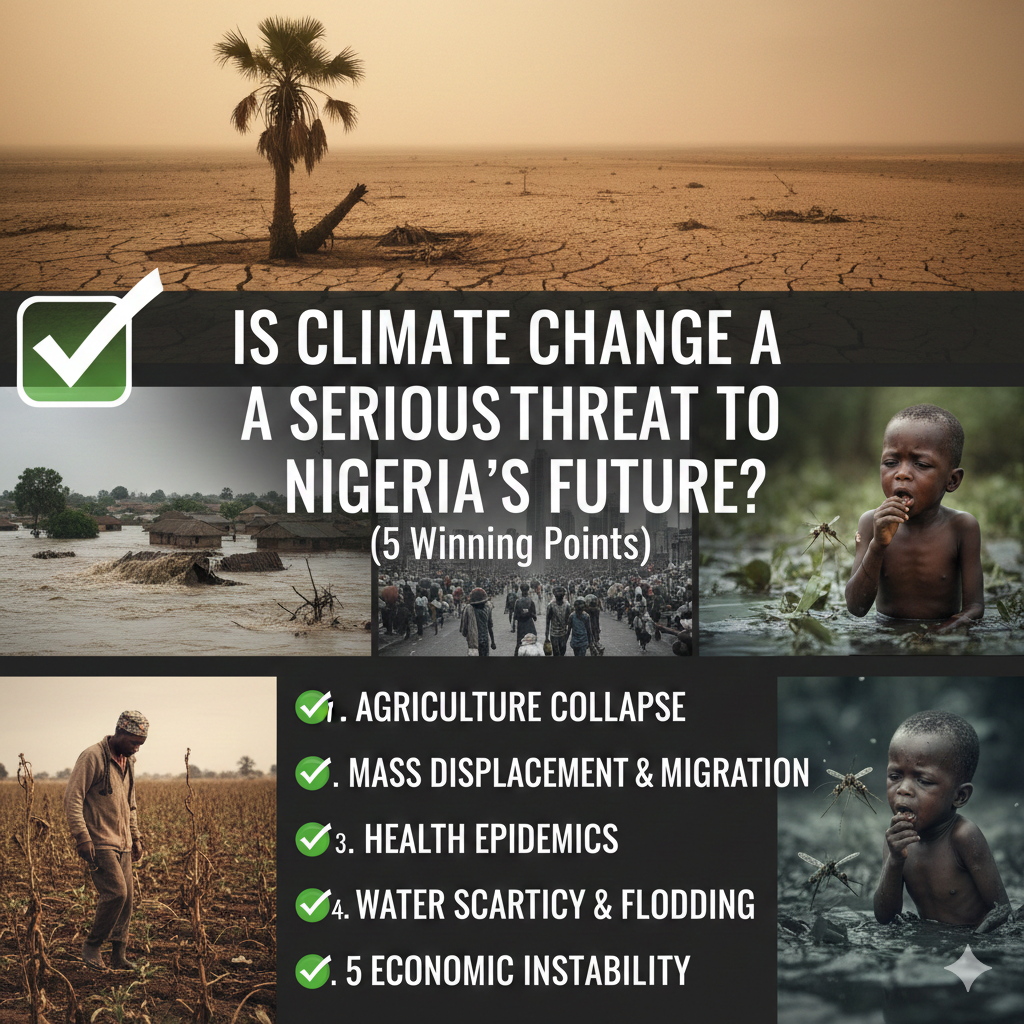
 Debate: Is Climate Change a Serious Threat to Nigeria’s Future? (5 Winning Points)
Good day, future leaders and brilliant debaters! Looking for powerful, ready-to-use points for your next competition? You’ve come to the right place. This template provides a complete script supporting the motion: Yes, climate change is a serious and urgent threat to Nigeria’s future.
Let’s be clear. When we talk about climate change, we mean the long-term shift in weather patterns and temperatures, primarily caused by human activities. A “serious threat” means something that can cause severe, lasting damage to our economy, our security, and our people’s well-being.
Disclaimer: This article provides structured arguments for one side of an educational debate. It is intended for learning and preparation, recognizing that all perspectives contribute to a full understanding of this critical issue.
—
Winning Debate Points on Why Climate Change is a Serious Threat
Here is your complete script. Deliver these points with confidence and conviction.
1. It’s an Economic Ticking Time Bomb
My first point is about our economy—the engine of our future. Climate change isn’t just an environmental issue; it’s a massive economic emergency. Think about it. Our economy relies heavily on agriculture and natural resources, both of which are directly in the line of fire.
Now, here’s the harsh truth. A major scientific study confirmed that while the effects might seem slow now, climate change negatively influences Nigeria’s economic growth in the long run. The World Bank warns that if we don’t act, climate disruptions could cost us up to 6% of our GDP by 2030. That’s millions of jobs lost. Billions of Naira washed away by floods or baked away by drought. We’re talking about damaged roads, destroyed farms, and skyrocketing food prices that already squeeze every family’s budget. How can we build a prosperous future when the very ground of our economy is so unstable?
2. Our Food Security Is Directly Under Attack
Let’s talk about the food on our plates. Over 35% of Nigerians work in agriculture. It’s our lifeblood. But climate change is poisoning that well. Rising temperatures and crazy, unpredictable rainfall are playing havoc with farming. Planting seasons are now a guessing game. Crops are failing.
The evidence is everywhere. In the North, desertification is swallowing farmland. In the South, floods are drowning it. The result? Rising food prices and frightening scarcity. In 2025 alone, food prices in Nigeria soared by over 35%. Imagine that. This isn’t a future problem. It’s happening today. Over 26 million Nigerians are already facing acute food insecurity. A nation that cannot feed its people is a nation in crisis. Is climate change a serious threat to Nigeria’s future? Ask any parent struggling to buy a bag of rice. They’ll tell you it already is.
3. It’s Creating a National Displacement Crisis
My third point is about our homes. Climate change is violently uprooting Nigerians from their lands. Remember the devastating 2022 floods? They weren’t just a news story. They were a national catastrophe.
That single disaster displaced over 2 million of our fellow citizens. Whole communities in states like Bayelsa and Anambra were erased by water. Schools and hospitals were destroyed. Families were forced into crowded camps. But here’s the thing: this is not a one-off event. It’s a terrifying new pattern. With projections showing more intense rainfall, millions more are at risk. Where will they go? This mass displacement strains our cities, deepens poverty, and creates a lost generation of children whose education and health are shattered. When our people are made refugees in their own country, our social fabric is torn apart.
4. It Fuels Conflict and National Insecurity
Now, let’s connect the dots to our safety. When resources disappear, people fight over what’s left. This is a brutal, simple truth playing out across Nigeria. As fertile land dries up in the North, herders are forced to move south to find pasture for their cattle.
This movement leads directly to clashes with local farmers. These aren’t just small disputes. They are deadly conflicts that have claimed thousands of lives. Climate change is the silent fuel for this violence. Furthermore, in the Northeast, groups like Boko Haram exploit the desperation caused by ruined livelihoods to recruit young people. So, climate change weakens our communities and empowers those who seek to destroy them. A nation battling internal conflict driven by a changing climate is a nation whose future security is under grave threat.
5. Our Current Action Is Too Slow and Fragmented
Finally, my last point is about our response. Yes, Nigeria has good policies on paper, like the Climate Change Act. But the painful reality is that implementation is critically slow. Our efforts are fragmented, with poor coordination between different government agencies. While we debate, the world is getting hotter. A major report states that 2025 will likely be one of the hottest years ever recorded for Nigeria.
We are underprepared. Our disaster management is more reactive than preventive. We are not moving fast enough on clean energy or climate-smart agriculture. The gap between our plans and our action is a vulnerability in itself. Facing a threat this big, hesitation is a form of surrender. Our window for effective action is closing fast. The time for vague promises is over. We need urgent, united, and massive action now.
—
Frequently Asked Questions (FAQs)
Q: What’s the strongest point the other side (the opposition) might use?
They might argue that climate change is a global problem and Nigeria’s contribution is small(we contribute about 0.26% of global emissions), so it’s not a serious threat to us. They may also say technology and adaptation will solve the problems. Your counter? While our emissions are low, we are among the world’s most vulnerable countries to its effects. We feel the consequences disproportionately. Waiting for others to act or for a tech miracle is a gamble with our national survival.
Q: How should I conclude my speech powerfully?
End with a strong,emotional appeal to national pride and common sense. Summarize your points briefly: the economic cost, the hungry children, the displaced families, the spreading conflict. Then ask: “With our economy, our food, our homes, and our peace at stake, can anyone truly say this is not a serious threat? The evidence is overwhelming. Let us not be the generation that saw the warning signs but chose to look away. Let us act now, for Nigeria’s future depends on it.”
—
Conclusion / Summary
To sum up, climate change poses a multi-front threat to Nigeria: it is crippling our economy, destroying our food security, displacing our citizens, fueling deadly conflicts, and outpacing our current efforts to stop it. The data from global and national agencies makes this undeniable.
Disclaimer: This debate template is for educational purposes to sharpen critical thinking and public speaking skills. The aim is to inform and prepare students for academic discourse.
What do you think? Do you have another winning point or a clever counter-argument? Drop your opinions in the comments section below! A good debater learns from every perspective. Also, feel free to share this post with your classmates or your entire debate team. Good luck
![How to Remember What You Read Without Taking Notes: 5 Shocking Methods [Stop Failing Now]](https://schoolsguide.name.ng/wp-content/uploads/2025/12/1766661763983-768x768.png)