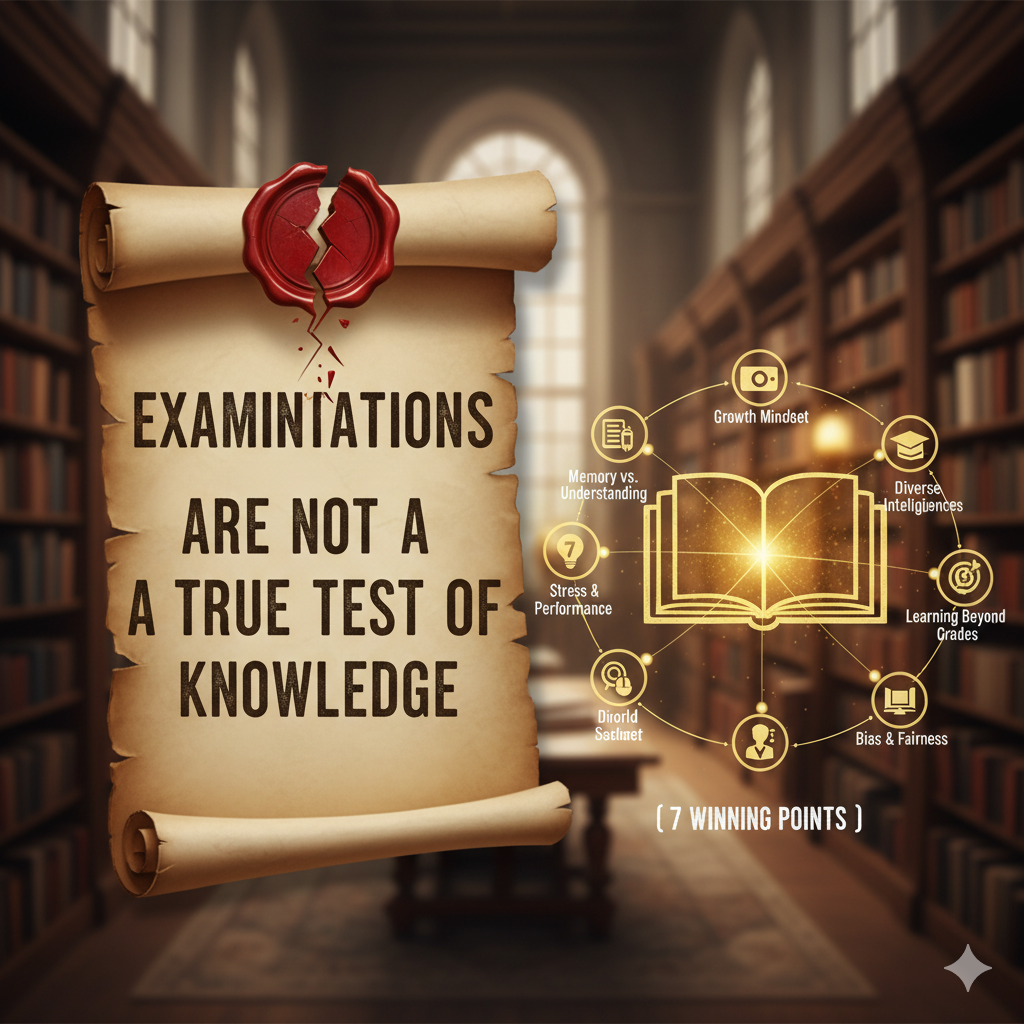
Examinations Are Not a True Test of Knowledge (7 Winning Points)
 Good day, future debate champions! Looking for powerful arguments for your next school competition? You’ve landed in the right place. Today, I’m giving you the exact script to prove that examinations are not a true test of knowledge.
Let’s be clear about what we’re discussing. An examination is that formal test where you sit in a hall with a question paper. Knowledge? That’s your actual understanding, your ability to apply what you’ve learned in real life. There’s a huge difference!
Important Note: This article provides strong points for one side of an educational debate. It’s not meant to disrespect teachers or the educational system. Debate is about building strong arguments, and that’s exactly what we’re doing here.
Winning Debate Points on Why Examinations Are Not a True Test of Knowledge
1. The Rote Memorization Trap
My first point hits at the very heart of the problem. Examinations force students into rote memorization. Think about it. What happens during exam season? We’re all cramming facts, dates, and formulas into our heads.
But here’s the truth: memorizing isn’t understanding. I can memorize a whole physics formula without knowing what it actually means. I can recite historical dates without understanding why those events mattered. The exam ends, and poof! The information disappears from my brain. Is that true knowledge? Of course not. Real knowledge sticks with you because you actually get it.
This creates a surface-level learning culture. We’re trained to perform, not to understand.
2. Exam Stress Destroys True Performance
Now, let’s talk about exam stress and anxiety. Ever walked into an exam hall with your heart pounding? Hands shaking? Mind going blank? We’ve all been there.
But here’s what’s unfair: that panic has nothing to do with what I actually know. The pressure of timed conditions messes with your brain. Scientific studies show that stress hormones actually block memory recall. So even if I studied hard and really understood the material, the pressure can make me forget everything.
Is that testing my knowledge? No! It’s testing my ability to handle stress. Some of the most knowledgeable students I know perform poorly under pressure. That doesn’t mean they don’t understand the subjects. It just means exams don’t work for them.
3. Where’s the Real-World Application?
Let me ask you this: when was the last time you used a quadratic equation at the market? Or wrote a formal essay to solve a problem with your friends? Exactly.
Examinations test theoretical knowledge that often has little connection to real-world application. Life doesn’t give us three hours to solve problems with a pen and paper. Life requires quick thinking, adaptability, and practical solutions.
I might ace a business studies exam but have no idea how to start an actual business. That’s because exams test book knowledge, not street smarts. True knowledge should help us in actual life situations, not just in examination halls.
4. They Kill Creativity and Critical Thinking
Examinations are all about standard answers. There’s usually one “correct” way to solve a problem. But what about creative solutions? What about thinking outside the box?
The marking schemes reward conformity, not innovation. If I have a brilliant but unusual way of solving a math problem, I’ll probably lose marks. If I have a creative interpretation of a novel, it might not match the examiner’s expectations.
This system stamps out critical thinking skills. We’re trained to guess what the examiner wants rather than developing our own ideas. True knowledge includes being able to think for yourself, not just repeating what textbooks say.
5. They Ignore Multiple Intelligences
Here’s something we all know but exams ignore: people are smart in different ways. Some of us are great with words. Others are brilliant with numbers. Some have amazing artistic talent. Others excel in sports or music.
But examinations only test a few types of intelligence. What about the student who can create beautiful art? Or the one who can fix any machine? Or the natural leader who can organize people? According to exams, these talents don’t matter.
That’s just wrong. True knowledge comes in many forms. By only measuring book smarts, examinations miss so much of what makes students truly knowledgeable and talented.
6. The Short-Term Memory Game
Think about your study pattern during exams. Be honest – do you remember what you studied last term? Probably not, because we’re all playing the short-term memory game.
We cram information right before exams, dump it on paper, and then forget it. That’s not learning – that’s temporary storage! According to educational research, most students forget over 50% of what they memorized within a few months.
Real knowledge should last. It should build over time. But the examination system encourages this cycle of learn-forget-relearn. How can something be a true test of knowledge when the knowledge disappears right after the test?
7. They Don’t Measure Actual Understanding
My final point is the most important one. You can pass an examination without truly understanding the subject. I’ve seen it happen all the time.
Students memorize model answers. They learn exam techniques. They figure out how to score marks without really grasping the concepts. That’s why you can have students with straight A’s who can’t explain the basic principles behind what they’ve studied.
True knowledge means you can explain concepts in your own words. You can teach it to someone else. You can apply it in new situations. Examinations rarely test for this deep understanding. They test for the ability to reproduce information, not truly comprehend it.
Frequently Asked Questions (FAQs)
What’s the strongest argument for the other side?
The opposition will likely argue that exams are objective and fair because everyone takes the same test under the same conditions. They might say exams are efficient for comparing large numbers of students. Your counter? Objectivity doesn’t equal truthfulness. A broken ruler gives the same wrong measurement to everyone – that doesn’t make it accurate!
How do I conclude this debate effectively?
End strong by summarizing your main points: “So, honorable judges, fellow debaters, we’ve seen how examinations test memory over understanding, stress management over knowledge, and conformity over creativity. True knowledge is so much more than what can be measured in a three-hour paper. It’s time we recognize that examinations are not a true test of knowledge and demand better ways to evaluate real learning.”
What if they say we need exams to maintain standards?
Counter this by agreeing that standards are important, but arguing that exams are the wrong way to maintain them. True standards should measure deep understanding and practical ability, not just exam performance. Project-based assessments and continuous evaluation can maintain high standards while actually measuring real knowledge.
Conclusion
We’ve covered seven powerful arguments showing why examinations are not a true test of knowledge. From testing memory over understanding to ignoring different types of intelligence, the evidence is clear. The current examination system has serious flaws that prevent it from measuring what students truly know and can do.
Remember: This is an educational debate exercise. We respect all views on this topic! The goal is to build strong arguments and improve our critical thinking skills.
What do you think? Drop your opinions in the comments section below! Did these points help you? Also, feel free to share this post with your classmates or those in your debate team! Let’s help each other win those competitions.