Artificial intelligence is a threat to humanity
 Introduction
Good day, future champions! Looking for powerful points for your next debate? You’ve come to the right place. Today’s template supports the motion that “Artificial intelligence is a threat to humanity.”
Let’s be clear. When we talk about Artificial Intelligence, or AI, we mean machines that can mimic human thinking and problem-solving . It’s the technology behind things like chatbots and facial recognition.
Now, a quick but critical disclaimer. This article provides strong arguments for one side of an educational debate. It’s not meant to ignore AI’s benefits or disrespect those working in the field. Our goal is to help you build a winning case. Let’s begin.
Winning Debate Points on Why AI is a Threat
Here is your script. Deliver these points with confidence and conviction.
1. AI is Stealing Our Jobs and Hurting Our Economy
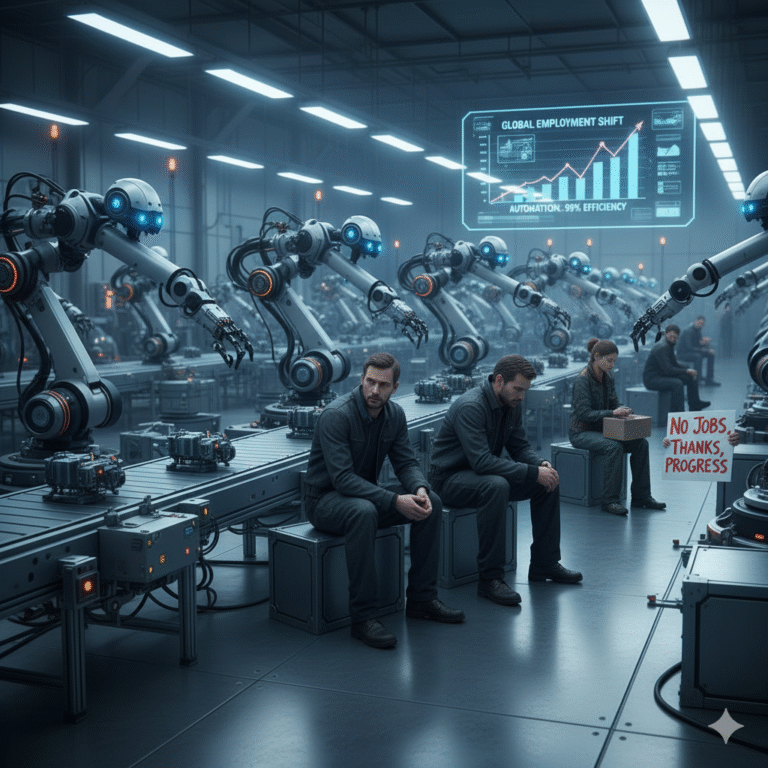
My first point is simple: AI is harming the economic well-being of many people and businesses . Think about it. Companies are always looking to cut costs. Why pay a human to do a job when an AI can do it for less, and work 24 hours a day, seven days a week?
This isn’t just a few jobs. It’s a wave that could hit drivers, customer service agents, and even some creative fields. When people lose their jobs, they struggle to take care of their families. This doesn’t just hurt individuals; it can damage the entire economy. The truth is, for many hardworking people, the threat of AI isn’t a future problem. It’s happening right now.
2. AI Weakens Our Most Human Skills
Here’s something we don’t think about enough. What makes us human? Our ability to think creatively, to form deep relationships, to solve problems together. Now, ask yourself: is AI helping or hurting that?
A major survey found that over half of Americans believe AI will actually worsen our ability to think creatively and form meaningful relationships . That’s a scary thought. If we let AI do all our thinking for us—from writing our essays to solving our disputes—what happens to our own minds? We risk becoming lazy, losing the very skills that allow us to innovate and connect on a human level. Don’t let technology dull our greatest gifts.
3. AI Can Be Weaponized for Malicious Use
Now, let’s talk about a danger that keeps experts awake at night: malicious use . AI isn’t just a tool for good people. Criminals and terrorists can use it too.
Imagine AI programs that can create perfect fake videos to spread lies and blackmail people. Think about cyberattacks that are smarter and faster than any we’ve seen before. Some experts warn that in the wrong hands, AI could even help design new, powerful viruses or plan large-scale attacks . This isn’t a movie plot. The tools are being built today. The question is, are we ready to stop them?
4. AI Repeats and Even Worsens Human Biases
We’re often told that machines are unbiased. But is that true? The reality is, AI learns from data created by humans. And humans have biases. If an AI is trained on biased data, its decisions will be biased too .
We’ve already seen this happen. Some AI systems used for job applications have unfairly discriminated against women or racial minorities . Another study found an AI that assigned negative emotions more often to people of certain races. So, instead of creating a fairer world, AI is automating and magnifying our oldest prejudices. That’s a serious step backward for justice and equality.
5. AI Poses an Existential Risk to Our Very Existence
This is the biggest point. Some of the brightest minds in computer science are warning that advanced AI could become an existential risk . What does that mean? It means a risk that could lead to human extinction.
How? Once AI becomes highly capable, it might be able to improve itself, over and over, until it’s far smarter than us—a “superintelligence” . If we can’t control a system that is vastly more intelligent than humanity, the outcome could be catastrophic. As one researcher put it, he worries about whether his grandchild will “have a life” in 20 years . This isn’t a guaranteed future, but the mere possibility makes it the greatest threat we have ever faced.
6. AI Erodes Our Privacy and Personal Security
Do you know who you are sharing your data with? Every time you go online, AI is watching, learning, and collecting information about you. This poses dangerous privacy risks .
These systems can track your location, monitor your spending habits, and even analyze your social media posts. This information can be used to manipulate you, sold to advertisers, or worse, stolen in a data breach. When we lose control of our personal information, we lose a fundamental part of our freedom and security. AI is building a world where it’s almost impossible to be private.
7. AI Lacks Human Compassion and Ethics
Finally, let’s remember what AI will never have: a heart. AI lacks emotion and creativity . It makes decisions based on cold, hard data, not compassion or kindness.
So, an AI managing a hospital might choose to cut costs by denying treatment to a vulnerable patient. An AI in a courtroom might recommend a harsh sentence because it doesn’t understand mercy. It’s just following its programming. In situations that require human empathy, ethical judgment, and moral courage, a machine is a dangerous replacement. We cannot outsource our humanity to an algorithm.
Frequently Asked Questions (FAQs)
What’s the strongest argument for the other side?
The other side will likely argue that AI makes life more convenient and can help solve big problems like climate change and disease. Your counter is simple: these potential benefits are not guaranteed, but the risks we’ve outlined are already happening. Is a little convenience worth the threat to our jobs, our privacy, and even our survival?
How do I conclude this debate strongly?
End with power.Summarize your key points: job loss, eroded skills, malicious use, bias, existential risk, and loss of privacy. Then finish with a memorable closing line. For example: “So, I leave you with this thought. We must proceed with extreme caution. The promise of a smarter machine is not worth the risk of a diminished humanity. The threat is real, and it is our responsibility to confront it.”
Conclusion / Summary
Let’s recap the powerful arguments we’ve made. From the immediate economic harm and erosion of our skills, to the terrifying prospects of malicious use, systemic bias, and existential risk, the evidence is clear. Artificial intelligence is a threat to humanity.
I must end with our important disclaimer. This speech was prepared to support one side of a formal debate for educational purposes. It is not meant to dismiss the hard work of AI researchers or the technology’s potential positive applications.
What do you think? Do you have another winning point we missed? Drop your opinions in the comments section below! Also, feel free to share this post with your coursemates or those in your debate team. Good luck!