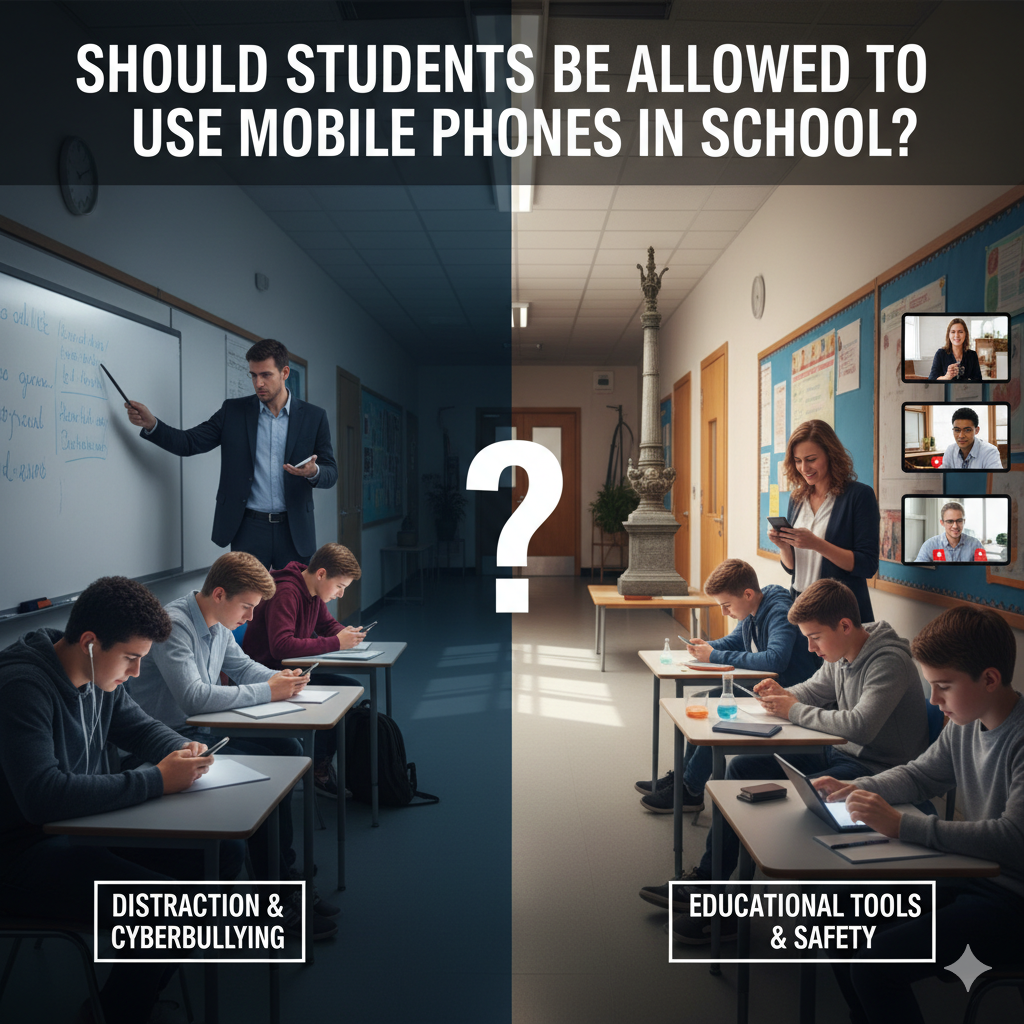
Should Students Be Allowed to Use Mobile Phones in School
 Perfect choice ✅ — that’s one of the most popular and thought-provoking debate topics in Nigerian secondary schools.
Here’s a complete, detailed, and lively debate presentation, ready for a school competition or class event.
-
Moderator’s Introduction
Good day, respected judges, teachers, and my fellow students.
You are all welcome to today’s debate on the topic:
👉 “Should students be allowed to use mobile phones in school?”
Speaking for the motion are those who believe students should be allowed to use mobile phones,
and speaking against the motion are those who believe students should not be allowed to use mobile phones in school.
—
Proposing Side (For the Motion)
Speaker 1 (Proposer):
Good day everyone. I stand to support the motion that students should be allowed to use mobile phones in school.
We live in a digital world where technology rules every aspect of life. Mobile phones are not just for calls—they are learning tools. With phones, students can easily access educational apps, dictionaries, research materials, and online lessons. Instead of carrying heavy textbooks, a student can read e-books and learn faster.
Secondly, phones help in emergencies. What if a student falls ill suddenly or faces an unsafe situation? A quick call can save a life.
Lastly, allowing phones teaches responsibility. Schools can set clear rules—like using phones only during breaks or for assignments. Banning phones completely is not the solution; teaching proper use is.
In this modern age, keeping phones away from students is like keeping them away from knowledge itself. Thank you.
—
Opposing Side (Against the Motion)
Speaker 1 (Opposer):
Respected judges, teachers, and students, I rise to oppose the motion that students should be allowed to use mobile phones in school.
While mobile phones can be helpful, in reality, they are more of a distraction than a learning tool. During lessons, students may chat, play games, or scroll through social media instead of paying attention. This reduces concentration and academic performance.
Also, phones encourage cheating during exams. With internet access, students can easily copy answers or take pictures of question papers.
Furthermore, phones can lead to moral decay. Many students use them to watch inappropriate content or take pictures for social media fame instead of focusing on their studies.
Therefore, allowing mobile phones in schools will cause more harm than good. Let’s keep our schools as centers of learning, not social media hubs. Thank you.
—
Proposing Side (Second Speaker):
Distinguished judges and audience, my worthy opponent says phones cause distraction, but that’s only when there is no supervision. If teachers guide students on responsible use, phones can enhance learning, not hinder it.
In many developed countries, phones are part of the classroom—used for quizzes, research, and language practice. Should Nigeria be left behind in technological education?
Moreover, students can use phones to record lectures, take notes, or participate in online discussions. Let’s not fear technology; let’s embrace it wisely. Thank you.
—
Opposing Side (Second Speaker):
Ladies and gentlemen, it is easy to say phones can help learning, but reality tells a different story. Most students use their phones for chatting, TikTok, or games—not for studying.
Phones can also cause theft and jealousy when some students bring expensive gadgets to school. This may lead to bullying or stealing.
Instead of phones, schools should provide computer labs and controlled internet access. That way, students can learn technology in a safe environment.
In conclusion, students should not be allowed to use mobile phones in school until they are mature enough to use them responsibly. Thank you.
—
Moderator’s Closing Remarks
Thank you to both sides for your strong and convincing arguments.
The floor is now open for the judges to decide which team has presented a better case—
Should students be allowed to use mobile phones in school, or should they not?
—