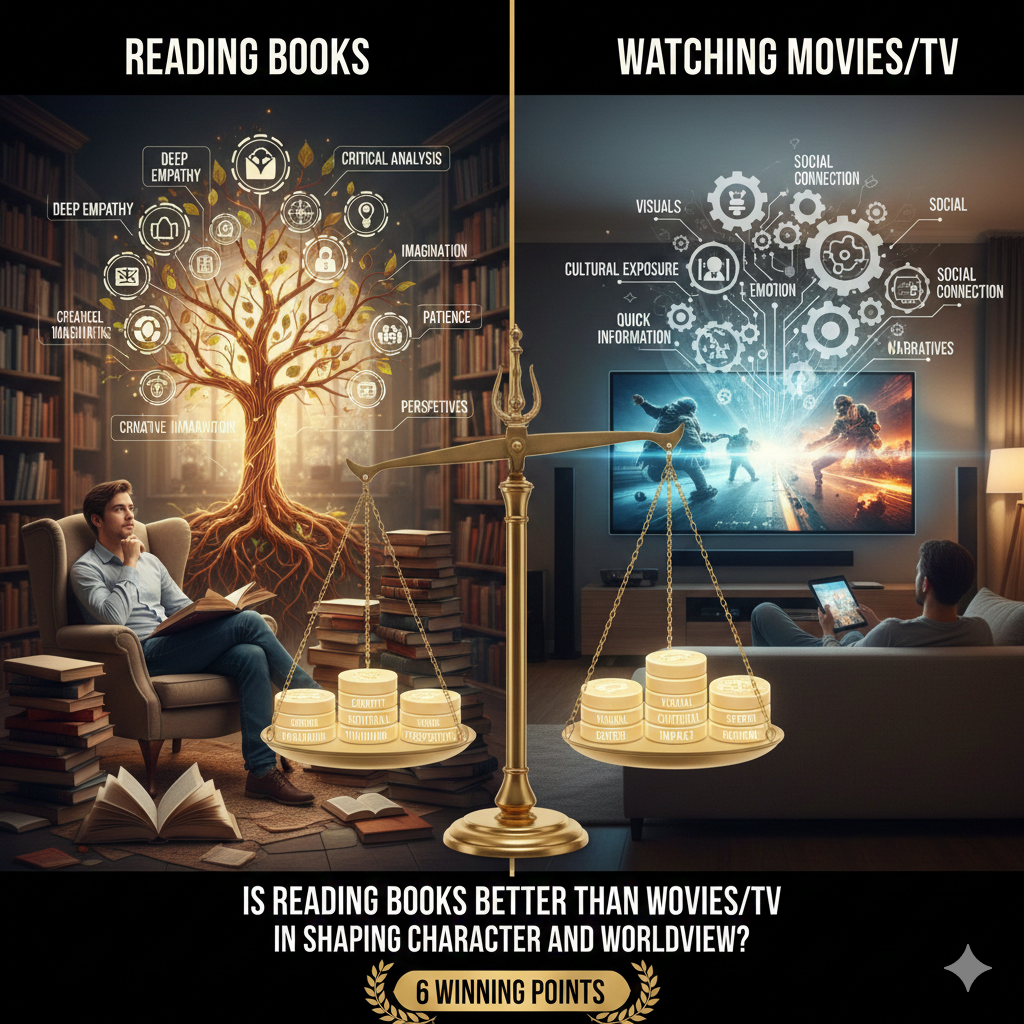
Is reading books better than watching movies/TV in shaping character and worldview?
 Debate: Is Reading Books Better Than Watching Movies/TV in Shaping Character and Worldview? (6 Winning Points)
Good day, future champions! Looking for the winning points for your next debate? You’ve come to the right place. This template provides a powerful, ready-to-use script supporting the motion: “Reading books is better than watching movies/TV in shaping character and worldview.” We’ll break down the benefits of reading and why it offers a deeper, more personal form of education for the mind and soul.
Let’s define our terms simply. “Shaping character and worldview” means forming our values, morals, and how we understand the world and other people. This article provides a template with arguments for one side of this educational debate. A great debater understands both sides, so use this to build your case, but always respect the opposing view.
—
Winning Debate Points on Why Reading is Superior
Here is your script. Deliver these points with confidence and conviction.
1. Books Build Your Imagination Muscle.
My first point is about the power of your own mind. When you read a book, you are the director. The words “dark, mysterious forest” force you to picture it. You cast the characters. You design the castle. This active engagement isn’t just fun—it’s a workout. It builds creativity, focus, and critical thinking in a way passive watching never can.
Think about it. A movie shows you their forest. It hands you everything on a plate. But a book? A book gives you the ingredients and says, “You cook.” This process of building worlds in your head is fundamental to developing a rich, unique inner life and a resilient, adaptable character. It’s that simple.
2. You Get a Front-Row Seat to a Character’s Soul.
Now, let’s talk about empathy. Books, especially great novels, let you hear a character’s private thoughts. You don’t just see Harry Potter be brave; you feel his fear, his doubt, his loneliness right there on the page. This intimate access is a masterclass in understanding people.
Watching a film, you see actions and hear dialogue. But you’re often an outsider. Reading makes you an insider. You live the character’s journey from the inside out. According to a study published by the American Psychological Association, reading literary fiction is linked to improved ability to understand others’ mental states. This is how books shape a compassionate, nuanced worldview—by letting you walk in another person’s shoes, mile after mile.
3. Reading is a Deep Dive, Not a Quick Splash.
Here’s the thing about depth. A movie has to tell its story in two hours. Complex plots get simplified. Rich book characters get flattened. But a book? A book has the time and space to explore ideas, histories, and motivations in incredible detail.
This depth directly shapes a more informed worldview. You don’t just learn that a revolution happened; you understand the slow-burning frustrations, the ideological debates, the personal costs. This breeds patience and the ability to see the grey areas in life, not just the black and white. It teaches you that the world is complex, and that’s a crucial lesson for character.
4. Your Brain Becomes an Active Partner, Not a Couch Potato.
Let’s be real. Watching TV is easy. The sounds, the quick cuts, the special effects—they do the work for you. Your brain can just… coast. Reading is different. It demands your participation. You must decode symbols, follow syntax, hold plot threads, and make connections.
This active cognitive engagement is like a full-gym session for your mind. It strengthens your concentration span and your analytical skills. In a world of constant distractions, the discipline and mental stamina you build from finishing a book are core aspects of a strong, focused character. You train yourself to finish what you start, to sit with complex ideas. That’s power.
5. Language Becomes Your Superpower.
Another key point is the magic of language. Books are written in language. Great books are written in beautiful, powerful language. When you read, you are immersed in vocabulary, sentence rhythm, and expressive metaphors. You absorb this subconsciously. Your own way of speaking and thinking becomes richer, more precise.
Can movies have great dialogue? Absolutely. But the volume and variety in reading are unmatched. This command of language shapes how you articulate your own worldview, how you persuade others, and how you understand complex concepts. It gives you the tools to shape your own character and express it to the world.
6. It’s a Personal Journey of Self-Discovery.
Finally, reading is a deeply personal conversation between you and the author. There’s no soundtrack telling you how to feel. No actor’s face dictating your reaction. It’s just you and the text. This creates a unique space for self-reflection. You can pause on a sentence that hits you. You can re-read a paragraph that changes your thinking.
This solitary journey forces you to confront your own beliefs and biases. You ask yourself, “What do I think about this?” That question is the very engine of building a personal, resilient character and a worldview that is truly your own, not one borrowed from a screen.
—
Frequently Asked Questions (FAQs)
What’s the strongest argument for the other side (that movies/TV are better)?
The most common strong point is that movies and TV are more accessible and can convey powerful visual emotions and cultural moments quickly to a wide audience,including those who find reading difficult. They argue that a well-made film can inspire empathy and social change on a massive scale.
How do I conclude this debate effectively?
Summarize your core message powerfully:”Therefore, Mr. Chairman, Panel of Judges, my fellow debaters, while visual media has its place, the act of reading remains the superior, more profound tool. It forges character through active imagination, deep empathy, and intellectual discipline. It builds a worldview from the inside out, making us not just spectators of stories, but active architects of our own minds. I rest my case.”
—
Conclusion / Summary
To wrap up, our winning points show that reading books is a more active, deep, and personal tool for shaping who we are. It builds imagination, fosters true empathy through inner dialogue, offers unmatched depth, trains the brain, enriches language, and prompts vital self-reflection. These are the cornerstones of a strong character and a thoughtful worldview.
Remember: This template is for educational debate purposes. Both books and visual media have immense value in our lives and culture. The goal here is to argue one side persuasively, fostering critical thinking and public speaking skills.
- What do you think? Drop your opinions in the comments section below! Did these points help? Also, feel free to share this post with your coursemates or those in your debate team! Good luck