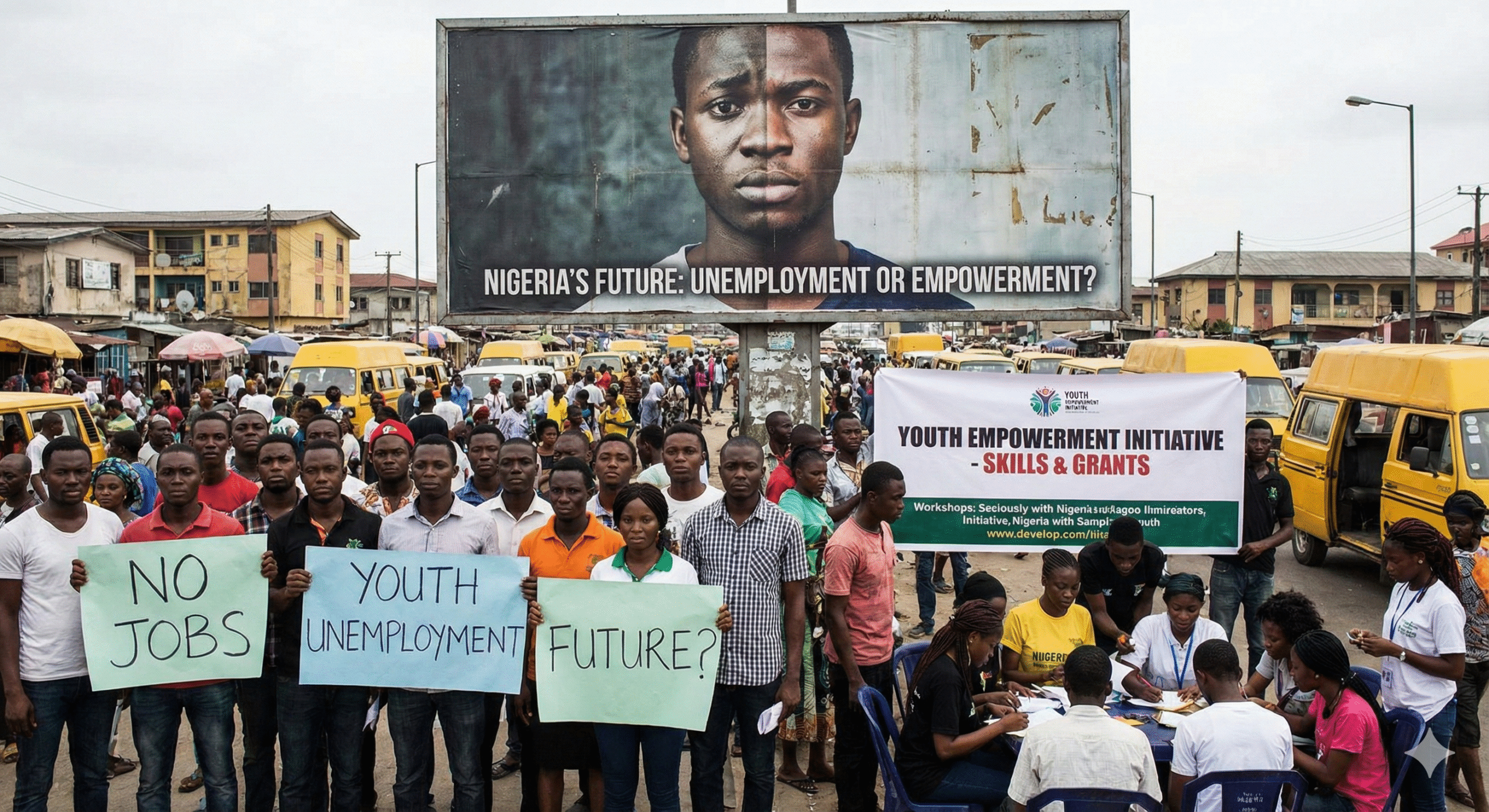
Is youth unemployment the biggest challenge facing Nigeria’s future? (or should government focus more on youth empowerment)
 Debate: Is Youth Unemployment Nigeria’s Biggest Challenge? (6 Winning Points)
Good day, future leaders and debaters! Looking for a powerful, ready-to-deliver script for your debate? You’ve hit the jackpot. Today, we’re tackling one of Nigeria’s most urgent motions: Is youth unemployment the biggest challenge facing Nigeria’s future?
This template provides the winning arguments supporting the motion. It’s crafted to sound like you—a passionate, informed Nigerian student speaking from the heart and backed by facts. Remember, this is an educational exercise. All perspectives are valuable, but our job today is to build an unbeatable case.
Let’s define our terms simply. “Youth unemployment” isn’t just graduates without office jobs. It’s the crippling idleness of over 80 million young Nigerians who are ready to work but have no opportunity. A “challenge” is a barrier so massive it threatens to collapse everything else—our economy, our security, our very future.
Now, step up to that podium. Here is your script.
Winning Debate Points on Why Youth Unemployment is Nigeria’s Prime Challenge
1. The Scale is a National Emergency
My first point is simple: you cannot solve what you do not measure. And the numbers measuring our youth job crisis are absolutely terrifying. We are not talking about a small problem. A recent 2025 report states that over 80 million Nigerian youths are unemployed. Let that sink in. Eighty million. That’s more than the entire population of many countries.
The unemployment rate for young people has soared to 53%. Think about it. For every two young people you know, statistically, one has no job. Furthermore, about 3.5 million new young Nigerians enter this saturated labour market every single year. Our economy is not creating nearly enough opportunities to keep up. This isn’t just a challenge; it’s a demographic time bomb. When the majority of your most energetic, productive population is sidelined, you don’t just have an economic issue—you have a full-blown national emergency.
2. It Directly Fuels Insecurity and Crime
Here is an uncomfortable truth we must confront: idle hands become dangerous hands. There is a direct, proven link between mass unemployment and the insecurity plaguing our nation. A study on youth in Ekiti State confirmed that empowerment programs which provide jobs and skills lead to a significant reduction in crime.
Why is this? The logic is human nature. When a young person with education, energy, and dreams faces a wall of “No Vacancy” for years, frustration sets in. This frustration, as research linked to national security shows, can be exploited and channeled into violence, crime, and unrest. From cybercrime to banditry, the recruitment pool is often our disenfranchised, unemployed youth. You cannot preach peace to a hungry stomach. You cannot have national security when millions of young citizens feel they have no stake in the society. Tackling unemployment isn’t just about creating jobs; it’s about disarming a primary engine of violence and creating a more stable Nigeria for everyone.
3. It Wastes Our Greatest Asset: The “Youth Bulge”
They call our young population a “demographic dividend.” A dividend is a bonus, a source of wealth. But right now, due to unemployment, we are not investing in this asset—we are watching it rot. Nigeria has one of the youngest populations on Earth, with a median age of just 18.1 years. This is our superpower in a rapidly aging world.
But a superpower unused becomes a supreme liability. The United Nations warns that if this surge of young people cannot find productive work, it will strain our social systems to breaking point. We are at a crossroads. We can either harness this incredible energy and innovation to build a digital powerhouse, as some envision, or we can let it fester into a generation of lost hope. The biggest challenge is ensuring this bulge becomes a boom, not a bomb. The choice, and the consequence, defines our future.
4. It Cripples Economic Growth and Productivity
Let’s talk economics. A nation’s wealth is built by the work of its people. So what happens when a huge portion of its workforce is inactive? Economic growth stalls. The socio-economic impact is devastating. These 80 million unemployed youths represent trillions of Naira in lost productivity, untaxed income, and stifled consumer spending.
Every day they are out of work, our GDP is lower than it could be. Poverty deepens. The government’s own revenue base shrinks, making it harder to fund schools, hospitals, and infrastructure. It’s a vicious cycle. Unemployment causes poverty, which limits education and investment, which leads to more unemployment. Breaking this cycle is the central task for any nation that wants to develop. You cannot build a thriving economy on a foundation of idleness. Therefore, mobilising this vast dormant workforce is not an economic priority—it is the fundamental prerequisite for sustainable growth.
5. It Renders Even Good Policies Ineffective
Some might argue that other issues, like education reform or infrastructure, are the root cause. I say unemployment is the bottleneck that makes solving those other issues impossible. Take education. We produce over 1.7 million graduates from tertiary institutions annually. But when these graduates flood into a jobless market, their degrees become pieces of paper. This creates a crippling skills mismatch. Students lose faith in the system.
Why strive for excellence if excellence leads to a jobless future? Furthermore, how can we fund better education or infrastructure if our productive economy is hamstrung by unemployment? Resources are limited. We must tackle the problem that multiplies other problems. Focusing on youth employment is the leverage point. Get young people into productive work, and you increase tax revenue, community stability, and demand for better services. It turns citizens from a cost into an asset for solving other national issues.
6. It is the Root of Social Disintegration and Lost Hope
Finally, look beyond the economics and statistics. Look at the human and social cost. Widespread youth unemployment corrodes the very fabric of our society. It leads to mass migration, both from rural areas to overcrowded cities and out of the country in dangerous journeys abroad. It breaks apart families and communities.
Most dangerously, it kills hope. When a generation feels it has no future, it loses faith in the social contract. It stops believing in hard work, integrity, and national unity. This loss of shared hope and purpose is the fastest route to national decline. Addressing youth employment is about more than economics; it’s about restoring the soul of Nigeria and giving our young people a reason to believe in and build their homeland.
—
Frequently Asked Questions (FAQs)
Q: What’s the strongest point the other side (the opposition) might use?
A:They will likely argue that “corruption” or “insecurity” is the biggest challenge, claiming it prevents job creation. Your counter is simple: corruption and insecurity are enabled by mass unemployment. A desperate, idle population is easier to exploit by corrupt actors and recruit into criminal gangs. Solving unemployment removes the fuel from these other fires. As one report states, joblessness is forcing millions into “dangerous coping mechanisms”. Fix the jobs crisis, and you weaken corruption and insecurity at their base.
Q: How should I conclude this debate speech powerfully?
A:Tie it back to the future. Say something like: “Honorable judges, fellow debaters, we are not just discussing statistics. We are debating the fate of 80 million dreams. We are deciding whether Nigeria’s legendary energy and creativity will be channeled into building a powerhouse or lost to despair and conflict. The evidence is clear. Youth unemployment is the bottleneck choking our economy, the tinder fueling our insecurity, and the threat wasting our greatest asset. To secure Nigeria’s tomorrow, we must employ its youth today. Thank you.”
Conclusion / Summary
In summary, the case is overwhelming. Youth unemployment is Nigeria’s biggest challenge because of its unprecedented scale (over 80 million affected), its direct role as a driver of insecurity and crime, its catastrophic waste of our demographic “superpower”, its crippling effect on economic growth, and its erosion of our social fabric and hope for the future.
Disclaimer: This template is provided for educational and debate preparation purposes only. It argues one side of a complex issue to develop critical thinking and public speaking skills. It is not intended to diminish the importance of other critical national issues or the hard work being done across all sectors.
What do you think? Do you agree that this is the defining challenge of our time? Drop your opinions or your own powerful rebuttals in the comments below! Also, feel free to share this post with your coursemates or teammates preparing for the same debate