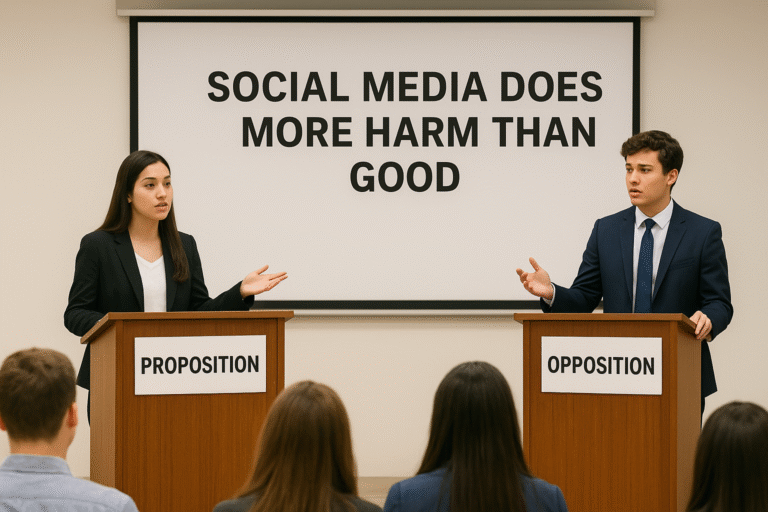
Students should be allowed to grade teachers
 🏆 Debate: Students Should Be Allowed to Grade Teachers (5 Winning Points)
Good day, future leaders and brilliant debaters!
Looking for powerful points to win your next debate? You’ve landed in the right place. This template provides a ready-to-use script for the motion: “Students should be allowed to grade teachers.”
Let’s be clear from the start. Grading a teacher doesn’t mean students are being disrespectful. It means giving structured, respectful feedback on their teaching methods. It’s about creating a partnership for better learning.
A quick but important disclaimer: This article provides arguments for one side of an educational debate. It is not meant to diminish the vital role of teachers, who are the backbone of our society. This is purely a tool to help you prepare for your competition.
Now, let’s get you those winning points.
🗣️ Winning Debate Points on Why Students Should Grade Teachers
Here are five powerful points you can use directly in your speech. Deliver them with confidence!
### 1. Students Are the True Experts of the Classroom Experience
My first point is simple: who knows the classroom better than us? We are the ones sitting through the lessons every single day. An administrator might pop in for ten minutes, but we experience over a thousand teaching hours a year. We see the good days and the bad days. We know which explanations made the lightbulb go off in our heads and which lessons left us confused. A 2025 report on educational reform even backs this up, stating that students are “immersed in the learning environment” in a way no outside observer ever can be . We are the direct consumers of education. Our perspective isn’t just helpful; it’s essential. It’s that simple.
### 2. It Gives Us a Voice and Empowers Us to Learn
Let’s talk about empowerment. Right now, the education system can feel one-sided. Teachers assess us, but we have no formal way to share our learning experiences. Allowing us to grade our teachers changes that. It gives us a legitimate voice. When we see that our opinions are valued and can lead to real changes, we become more invested. Research has shown that when students feel heard, they become “more enthusiastic, active citizens within their school” . We stop being passive recipients of information and start becoming active partners in our own education. That’s a powerful shift.
### 3. The Real Goal is Teacher Improvement, Not Punishment
Now, some might say we just want to criticize. That’s not it at all. The real purpose is to help our teachers grow, just like they help us. Think of it as constructive feedback, not a complaint box. For instance, if many students report that a teacher speaks too fast, that teacher now has a clear, specific area to improve. This isn’t about getting anyone in trouble. It’s about providing a roadmap for excellence. This kind of mid-semester feedback gives instructors “immediate information about what’s working and what isn’t,” allowing them to make real-time adjustments that help everyone . We want our teachers to succeed because their success is our success.
### 4. It Prepares Us for a Future Where Feedback is Normal
Think about the world we are entering. In universities, student evaluations are standard practice—over 94% of colleges use them systematically . In the workplace, employees regularly receive and give feedback to their managers. By introducing this process in secondary school, we are not being radical. We are being prepared. We are learning the crucial adult skill of giving respectful, constructive criticism. This experience teaches us to articulate our thoughts clearly and helps break down the fear of speaking up. It prepares us for the real world, where communication and continuous improvement are keys to success.
### 5. It Directly Builds a Better School Culture
My final point is about our school’s atmosphere. A school where everyone’s voice matters is a school where everyone feels respected. When teachers and students communicate openly, it builds trust and breaks down the “us versus them” barrier. This creates a collaborative environment where we all work together towards a common goal: excellent education. This feedback loop helps create what experts call “enriched learning cultures” and contributes to a “flourishing school culture” . Imagine a school where students and teachers are on the same team, openly working to make every class the best it can be. That’s the school we can build together.
❓ Frequently Asked Questions (FAQs)
What is the strongest argument for the other side?
The most common counter-argument is that student evaluations can be biased.Critics say students might give a low grade to a strict teacher who challenges them, or that personal feelings can cloud judgment . In your rebuttal, you can argue that proper survey design—focusing on specific teaching methods rather than personal likability—can minimize this bias.
How should I conclude this debate speech?
End by summarizing your strongest points with conviction.You could say: “In conclusion, allowing students to grade teachers is not about disrespect. It is about partnership, improvement, and preparing for the future. It leverages our unique classroom experience to help teachers grow and empowers us to take ownership of our learning. For a more dynamic, responsive, and effective education, I urge you to support this motion.”
✅ Conclusion / Summary
To recap, we’ve covered five key arguments: we are the experts of the classroom experience, this process empowers us, its true goal is teacher improvement, it prepares us for the future, and it builds a stronger, more positive school culture for everyone.
Remember, this is a debate: The arguments here are for educational purposes to help you win your competition. We deeply respect our teachers and acknowledge their profession’s immense importance. This motion is about creating a dialogue for progress.
What do you think? Drop your opinions in the comments section… Let’s get a discussion going! Also, feel free to share this post with your coursemates or those in your debate team. Good luck